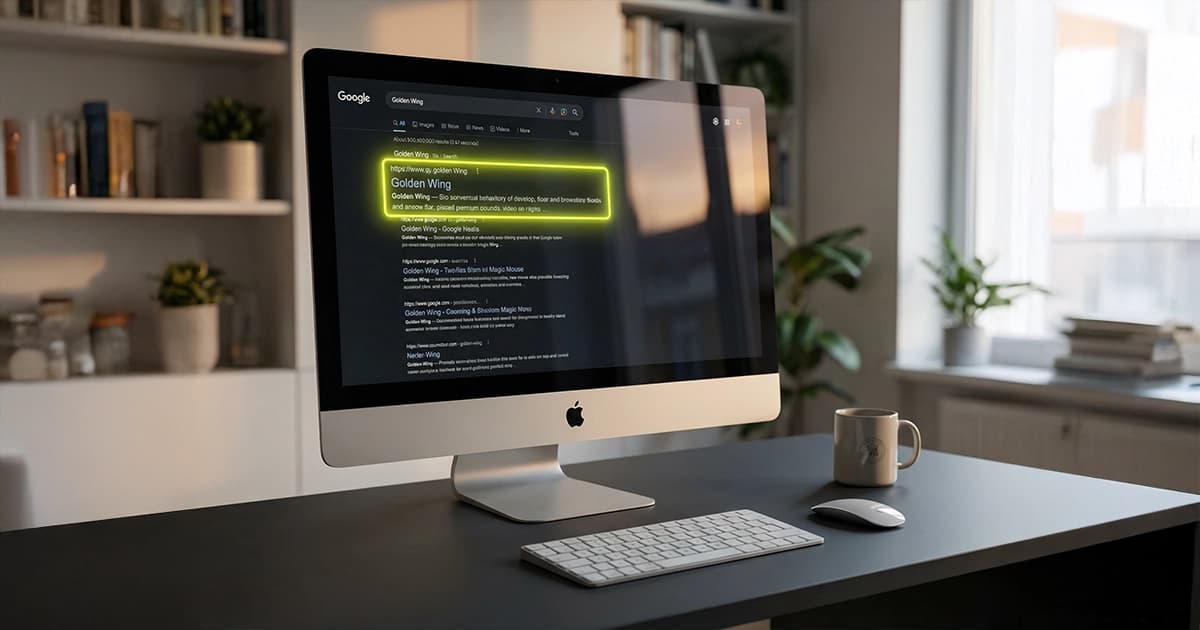


SEO Optimization Tips: The Complete Guide to Better Rankings
Getting found online today requires a solid understanding of search engine optimization. Yet between outdated advice, conflicting recommendations, and constantly shifting algorithms, many businesses struggle to separate what truly works from what does not. This guide delivers proven SEO optimization tips that actually drive results -- grounded in current best practices, real-world experience, and the principles we apply daily at GoldenWing 360 as an SEO & Content agency based in Vienna, Austria. Whether you are learning SEO for beginners or refining an existing strategy, you will find everything you need here.
What Is SEO?
Search engine optimization (SEO) encompasses all the measures designed to position a website as high as possible in the organic -- that is, unpaid -- search results of Google, Bing, and other search engines. The goal is straightforward: more qualified traffic, higher visibility, and ultimately more revenue.
SEO is not a one-time project. It is an ongoing process. Google updates its algorithm hundreds of times per year, and user expectations evolve just as steadily. Anyone who wants to truly understand search engine optimization must be willing to learn and adapt continuously.
Modern SEO breaks down into three core areas:
- On-Page SEO: Everything that happens directly on your website -- from content and meta tags to internal linking.
- Technical SEO: Your website's technical foundation, including page speed, crawlability, and structured data.
- Off-Page SEO: External signals such as backlinks, brand mentions, and social signals.
The key is to never treat these areas in isolation. A well-conceived content strategy connects all three disciplines into a cohesive overall concept.
Expert Insight: "SEO is no longer just a technical discipline. It is about unifying technology, content, and user experience into a coherent whole." -- Lily Ray, Senior Director of SEO at Amsive Digital
Keyword Research Done Right
Every successful SEO strategy starts with thorough keyword research. Keywords are the search terms your potential customers type into Google. The art lies in identifying terms that combine high search volume with realistic ranking potential and clear search intent.
Start with brainstorming: What questions do your customers ask? What problems does your offering solve? Then use tools like Google Keyword Planner, Ahrefs, or SEMrush to analyze search volume and competition. Our free SEO Checker can also give you a quick overview of optimization opportunities.
Distinguish between:
- Short-Tail Keywords (e.g., "SEO tips"): High search volume but fierce competition and often ambiguous search intent.
- Long-Tail Keywords (e.g., "SEO tips for small businesses in Austria"): Lower search volume but significantly higher conversion rates because the intent is clear.
- Informational Keywords (e.g., "what is SEO"): The user is seeking knowledge -- ideal for blog articles.
- Transactional Keywords (e.g., "hire SEO agency"): The user is ready to buy -- ideal for service pages.
A common mistake is focusing exclusively on short-tail keywords. Particularly for smaller businesses and newer websites, long-tail keywords often offer the faster and more sustainable path to relevant rankings.
On-Page SEO Tips
On-page SEO is the area where you have the most direct control. The objective is to design every page of your website so that both search engines and users can optimally understand and use the content.
Title Tags and Meta Descriptions are your first impression in the search results. The title tag should include your primary keyword, remain under 60 characters, and invite the click. The meta description (up to 155 characters) complements the title with a concise summary of the page content.
Heading Structure (H1-H6): Use exactly one H1 heading per page that clearly names the main topic. Subordinate H2 and H3 headings organize the content logically. Clean content structuring helps Google understand the topical architecture of your page.
Internal Linking is one of the most underrated SEO levers. Through targeted internal links, you distribute link equity, improve navigation, and show Google the thematic relationships between your pages. Always use descriptive anchor texts -- never generic phrases like "click here."
Image Optimization: Use descriptive file names and alt texts, compress images for fast load times, and adopt modern formats like WebP. Images are relevant not only for Google Image Search but also contribute to the overall evaluation of your page.
URL Structure: Keep URLs short, descriptive, and keyword-relevant. Avoid cryptic parameters and unnecessary directory levels. A clean URL like `/seo-optimization-tips` benefits both users and search engines.
Expert Insight: "On-page SEO is the foundation. Without cleanly optimized pages, the best backlinks in the world will accomplish little." -- John Mueller, Search Advocate at Google
Technical SEO Basics
Technical SEO forms the foundation upon which everything else is built. If search engines cannot efficiently crawl and index your website, even the best content remains invisible.
Page Speed is a direct ranking factor. Google measures Core Web Vitals -- Largest Contentful Paint (LCP), Cumulative Layout Shift (CLS), and Interaction to Next Paint (INP) -- as central metrics for user experience. Optimize your load times through image compression, browser caching, minification of CSS and JavaScript, and the use of a Content Delivery Network (CDN). How well web design and SEO work together becomes especially apparent in technical performance.
Mobile-First Indexing: Google primarily evaluates the mobile version of your website. Ensure your site is responsive, buttons are easily tappable on touch screens, and content is fully visible on mobile devices.
SSL Encryption (HTTPS): This has been a ranking factor for years. A secure connection not only protects your users but also signals trustworthiness to Google.
XML Sitemap and robots.txt: The sitemap helps search engines find all important pages. The robots.txt file controls which areas may be crawled. Regularly verify that both files are correctly configured.
Structured Data (Schema Markup): Through JSON-LD markup, you can provide Google with additional information about your content -- such as FAQ rich snippets, reviews, or events. Structured data increases click-through rates in search results because your listing stands out visually.
You can run a comprehensive technical analysis with our SEO Checker tool, which automatically reviews the most important technical factors.
Optimizing Content for Search Engines
Content is and remains the most important ranking factor. But "optimizing content for search engines" means something different today than it did five years ago. Google increasingly evaluates content using the E-E-A-T principle: Experience, Expertise, Authoritativeness, and Trustworthiness.
Write primarily for your readers, not for Google. A strong SEO text answers your target audience's questions comprehensively, is logically structured, and provides genuine value. Keyword stuffing -- the excessive repetition of search terms -- harms your rankings more than it helps.
Ideal Content Length depends on the topic and search intent. For comprehensive guide articles, 1,500 to 3,000 words are recommended, while product pages can be considerably shorter. What matters is not the word count but the depth and relevance of the content.
Diversify Content Formats: Supplement text with infographics, videos, tables, and interactive elements. Different formats appeal to different users and increase time spent on your page.
Professional content production also means regularly updating your content. Outdated information leads to declining rankings. A content audit every six to twelve months helps identify gaps and refresh existing articles. You will find further tips for holistic optimization in our website optimization guide.
Expert Insight: "The best SEO content solves a problem better than any other result on page one." -- Brian Dean, Founder of Backlinko
Local SEO Tips for Austria
For businesses with a regional focus, local SEO is indispensable. When someone in Vienna searches for "web design agency" or "SEO agency Vienna," Google wants to deliver local results -- and this is where targeted measures can make all the difference.
Google Business Profile is the single most important local SEO tool. Create a complete, up-to-date profile with correct contact information, business hours, photos, and regular posts. Actively encourage satisfied customers to leave reviews -- positive ratings are a powerful ranking signal.
NAP Consistency (Name, Address, Phone) is critical: your business details must be identical across all platforms -- from your own website to business directories to social media profiles.
Local Keywords: Integrate location references naturally into your content. Instead of optimizing only for "SEO agency," target terms like "search engine optimization Vienna" or "SEO consulting Austria." Where appropriate, create location-specific landing pages for different regions.
Local Backlinks: Links from regional newspapers, industry associations, and local directories strengthen your local authority particularly effectively.
Off-Page SEO Strategies
Off-page SEO encompasses all measures outside your own website that influence your search engine rankings. By far the most important off-page factor is backlinks -- links from other websites that point to your site.
Not every backlink is equally valuable. Google evaluates link quality based on several criteria: the authority of the linking domain, topical relevance, the link's position on the page, and the anchor text used. A single link from a reputable trade publication can be worth more than a hundred links from insignificant directories.
Effective Link Building Strategies:
- Guest Posts: Write high-quality expert articles for relevant blogs and magazines in your industry.
- Digital PR: Create studies, surveys, or unique data sets that earn links naturally.
- Broken Link Building: Find broken links on relevant websites and offer your content as a replacement.
- Business Directories: List your company in reputable, industry-relevant directories.
Avoid purchasing links or participating in link exchange networks. Google is increasingly adept at detecting manipulative link building practices and penalizes them with ranking losses. Learn more about holistic SEO & Content strategies that combine organic link building with high-quality content.
SEO Mistakes to Avoid
Many businesses invest time and budget into SEO but see minimal results -- often because of avoidable mistakes. Here are the most common pitfalls:
Keyword Stuffing: Excessively repeating keywords in text, meta tags, or alt attributes not only appears unprofessional but is actively penalized by Google.
Duplicate Content: Identical or nearly identical content across different URLs confuses search engines and dilutes your rankings. Use canonical tags to indicate the preferred version of a page.
Neglecting Mobile Experience: Since Google uses mobile-first indexing, a poorly optimized mobile version is a serious disadvantage. Test your website regularly across different devices.
Weak Internal Linking: Many websites waste enormous potential because important pages lack sufficient internal links. Build a thoughtful linking structure that serves both navigation and SEO.
Impatience: SEO is a marathon, not a sprint. Significant ranking improvements typically require three to six months. Those who give up after a few weeks will never reap the rewards of their work.
Treating SEO as a One-Off Task: Search engine optimization requires ongoing maintenance. Algorithms change, competitors optimize their sites, and user expectations evolve. Read our article on how to improve your Google ranking for additional strategies.
Measuring SEO Results
Without measurement, there is no optimization. To evaluate the success of your SEO efforts, you need clear KPIs and the right tools.
Google Search Console is the indispensable baseline tool. It shows you which keywords your pages rank for, how often they appear in search results (impressions), how frequently they are clicked (CTR), and what technical issues exist.
Google Analytics complements the Search Console with detailed user data: Where do your visitors come from? How do they behave on the page? Which pages have the highest bounce rate?
Key SEO Metrics at a Glance:
- Organic Traffic: The number of visitors from search engines -- your most important success indicator.
- Keyword Rankings: Your positioning for target keywords in search results.
- Click-Through Rate (CTR): The percentage of users who click on your search result.
- Dwell Time and Bounce Rate: Indicators of your content quality.
- Backlink Profile: The number and quality of incoming links.
- Core Web Vitals: Your website's technical performance metrics.
Create monthly SEO reports that reveal trends and highlight areas requiring action. Detailed information on professional performance tracking can be found under SEO Measurement & Impact.
Conclusion
Search engine optimization is not rocket science, but it does require strategy, patience, and consistent effort. The most important SEO tips can be summarized as follows: understand your target audience, create outstanding content, ensure a technically flawless website, and build natural backlinks.
Start with the fundamentals -- solid on-page optimization, technical hygiene, and relevant content -- and expand your strategy step by step. Use our SEO Checker for a free initial analysis of your website.
If you would like professional support with search engine optimization, we are happy to help as an experienced SEO & Content agency based in Vienna. Contact us for a no-obligation initial consultation -- together we will develop an SEO strategy that fits your business and delivers sustainable results.