

What is brand identity vs. brand image? {#brandidentity-vs-brandimage}
The termBrand identityis often confused with brand image - but the two concepts describe fundamentally different perspectives. If you want to build a strong brand, you need to understand this difference.
Brand identity(Brand Identity) is thatSelf-imageof your company. It describes what your brand stands for, what values it represents and how it positions itself in the market. The brand identity is actively designed and controlled by the company. It is the strategic basis for all communicative and design decisions.
Brand imagehowever, that isForeign image– i.e. the actual perception of your brand by customers, partners and the public. The brand image is created by the sum of all experiences and impressions that people have with your brand.
| Feature | Brand Identity | Brand Image |
|---|---|---|
| Perspective | Internal view (company) | External view (market/customers) |
| Controllability | Can be actively shaped | Can only be influenced indirectly |
| Origin | Strategic planning | Experiences & perception |
| Example | “We are innovative and sustainable” | “They look modern and environmentally conscious” |
| Responsibility | Marketing & Management | Arises with the target group |
The goal of professional brand development is to...Gap between identity and imageto keep it as small as possible. If your brand is perceived externally exactly as you have defined it, then your brand work is successful.
AtGoldenWingWe work with a proven process that takes both sides into account: First, we define the desired identity together with you, then we check the current image through market research - and close the gap with targeted measures.
Why brand identity is crucial for SMEs
A clear brand identity is a decisive competitive advantage, especially for small and medium-sized companies in Austria. In a market where products and services are becoming increasingly interchangeable, brand is often the only real differentiator.
Studies show that companies with a consistent brand presentationIncrease sales by up to 23%can. Investing in a professional brand identity pays off immediately - not only in terms of perception, but also in your account.
You can find out more about the basics in ourLexicon entry on corporate identity.
The 7 elements of a strong brand identity {#seven-elements}
A brand identity consists of several interlocking building blocks. Each element must be able to stand on its own and at the same time contribute to the overall picture. Here they are7 core elements, which we at GoldenWing define for every branding project:
1. Brand vision
The vision describes the long-term goal of your company. She answers the question:Where do we want to go?A good vision is ambitious but achievable. It inspires employees and gives direction to the entire organization.
Example:“We make digital excellence accessible to every company” – that could be a vision for a digital agency.
2. Brand mission
While the vision describes the goal, the mission explains theWay there. It answers: What do we do, for whom and why? The mission is more concrete than the vision and describes the daily task.
3. Brand values
Values are thoseGuardrailsof your actions. You define what is important to your company and what all decisions are based on. Ideally, you choose 3 to 5 core values that are authentic and reflected in everyday company life.
| Strong brand values | Weak brand values |
|---|---|
| Specific and differentiating | Generic and interchangeable |
| “Radical transparency” | “Quality” |
| “Inconvenient honesty” | “Customer satisfaction” |
| “Perfect craftsmanship” | “Innovation” |
4. Brand personality
If your brand were a person, how would it appear? Brand personality makes your brandhuman and tangible. It influences the communication style, the imagery and the overall appearance.
Well-known archetypes are:
- The hero– courageous, determined, performance-oriented (Nike)
- The wise one– competent, analytical, trustworthy (Google)
- The creative one– visionary, expressive, individual (Apple)
- The carer– caring, empathetic, protective (Dove)
5. Brand positioning
Positioning describes yoursunique place in the market. It defines how you stand out from the competition and what specific benefits you offer. A clear positioning answers:
- Who are our ideal customers?
- What problem are we solving?
- Why do we solve it better than others?
- What makes us unique?
6. Brand Voice
The brand voice defines,HowYour brand communicates. It includes tonality, language style and choice of words. More on this in the sectionDefine brand voice & tone.
7. Visual design
Visual design is the most visible part of the brand identity. It includes logo, colors, typography, imagery and all graphic elements. Details can be found in the sectionCreate visual design system.
All 7 elements mustcoordinated with each otherbe. A company that defines "innovation" as a core value but uses an outdated logo and communicates in conservative language creates a contradiction that undermines credibility.
OurBranding servicesinclude the development of all 7 elements in an integrated process. Also take a look at oursReferencesto see how we've implemented these elements for other companies.
Carry out a brand audit {#brand-audit}
Before you develop or revise your brand identity, you need an honest inventory. ABrand Auditsystematically analyzes the current state of your brand – from visual consistency to customer perception.
The 4 steps of a brand audit
Step 1: Internal analysis
Gather all existing brand materials: logo variants, business cards, website, social media presence, brochures, presentations, email signatures. Check for consistency. Do all materials use the same colors, fonts and tonality?
Step 2: Employee survey
Interview employees from different departments:
- How would you describe our brand in 3 words?
- What sets us apart from the competition?
- What values do we really live by?
- Where do you see contradictions in our external representation?
Step 3: Customer perception
Conduct customer surveys or analyze existing data: reviews, testimonials, support requests and social media comments. Compare customer perception with your self-assessment.
Step 4: Competitor analysis
Analyze 3 to 5 direct competitors in terms of positioning, visual identity and communication style. Identify gaps and opportunities for differentiation.
Brand audit checklist
| Area | Checkpoints | Status |
|---|---|---|
| Logo | Uniform use, topicality, variants | ☐ |
| Colors | Consistency across all media, contrasts | ☐ |
| Typography | Consistent fonts, readability | ☐ |
| Imagery | Consistent style, quality, authenticity | ☐ |
| Texts | Consistent tone of voice, error-free language | ☐ |
| Website | Current, UX, mobile optimization | ☐ |
| Social Media | Consistent branding, regular activity | ☐ |
| Printed matter | Topicality, uniform design | ☐ |
The results of the brand audit form the basis for all further steps. Without this honest analysis, you run the risk of making the wrong adjustments.
Target group analysis for your brand {#target group analysis}
A brand identity doesn't emerge in a vacuum - it has toright target grouparrive. That’s why a thorough target group analysis is part of every branding process.
Create buyer personas
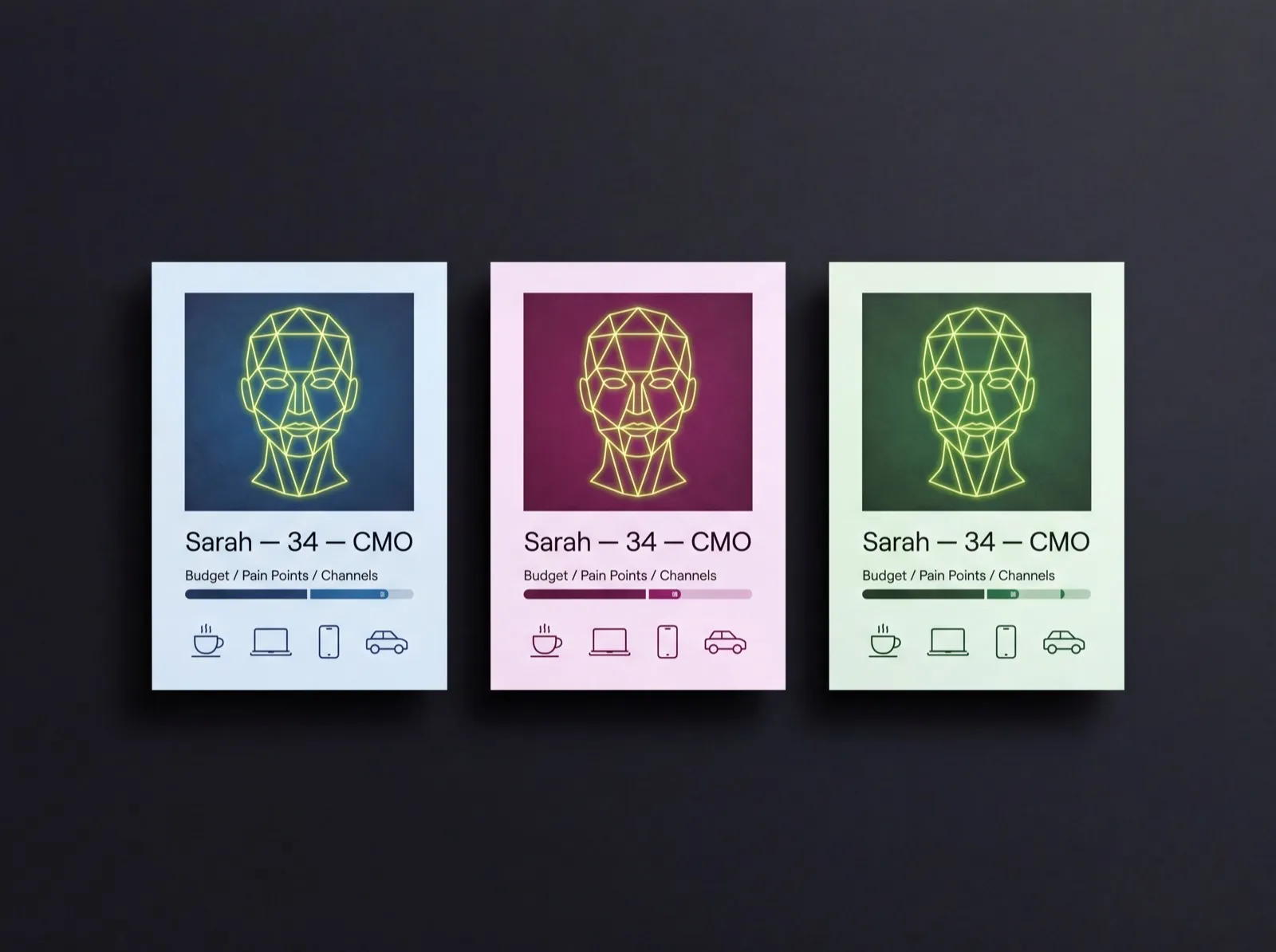
A buyer persona is a semi-fictional profile of your ideal customer. For effective brand development you should2 to 4 personasdefine which represent your most important customer segments.
Each persona should contain the following information:
- Demographics:Age, gender, income, place of residence, occupation
- Psychographic data:Values, interests, lifestyle, attitudes
- Pain points:What problems does the person have?
- Goals:What does the person want to achieve?
- Media usage:Which channels does the person use?
- Buying behavior:How does the person make purchasing decisions?
Empathy mapping
This is a complementary methodEmpathy mapping. For each persona you examine:
- What does she think and feel?Fears, hopes, priorities
- What does she say and do?Behavior in public, statements
- What does she see?Environment, competition offers, market trends
- What does she hear?Recommendations from friends, media reports, expert opinions
This analysis will help you develop a brand identity that resonates emotionally. Because ultimately it is emotions – not facts – that drive purchasing decisions.
You can read more about customer understanding in our article aboutCustomer journey mapping.
Define Brand Voice & Tone {#brand-voice-tone}
The brand voice is theverbal personalityyour brand. It determines how your brand sounds – in every text, on every platform and in every interaction.
Voice vs. Tone – the difference
TheVoiceis constant. It is your brand's basic communication style - for example, "professional but approachable" or "bold and direct." The voice doesn't change whether you're writing a social media post or a press release.
TheClayshowever, is variable. He adapts to the respective situation. A brand can be humorous on social media and serious in crisis communication - but the fundamental voice remains the same.
Brand Voice Framework
Define your voice based on4 dimensions, each on a scale:
| Dimension | Scale | Your Brand |
|---|---|---|
| formality | formal ←→ casual | __________ |
| Energy | Calm ←→ Energetic | __________ |
| Humor | Serious ←→ Humorous | __________ |
| Authority | Advisory ←→ Determining | __________ |
Create word list
Make a list of words and phrases your brand uses – and a list of words theynotused:
We say:
- “Together we develop…”
- “Your project deserves…”
- “Data-based results”
- “Transparent collaboration”
We don't say:
- “We are the best…”
- “Cheap and fast”
- “Guaranteed results”
- "You could maybe..."
These word lists are part of the brand guidelines and help everyone who writes texts for your brand to hit the right tone. Whether intern or CEO – everyone communicates consistently.
You can see what this looks like in practice with oursProject references, where we developed individual brand voices for different industries.
Create a visual design system {#visual-design-system}
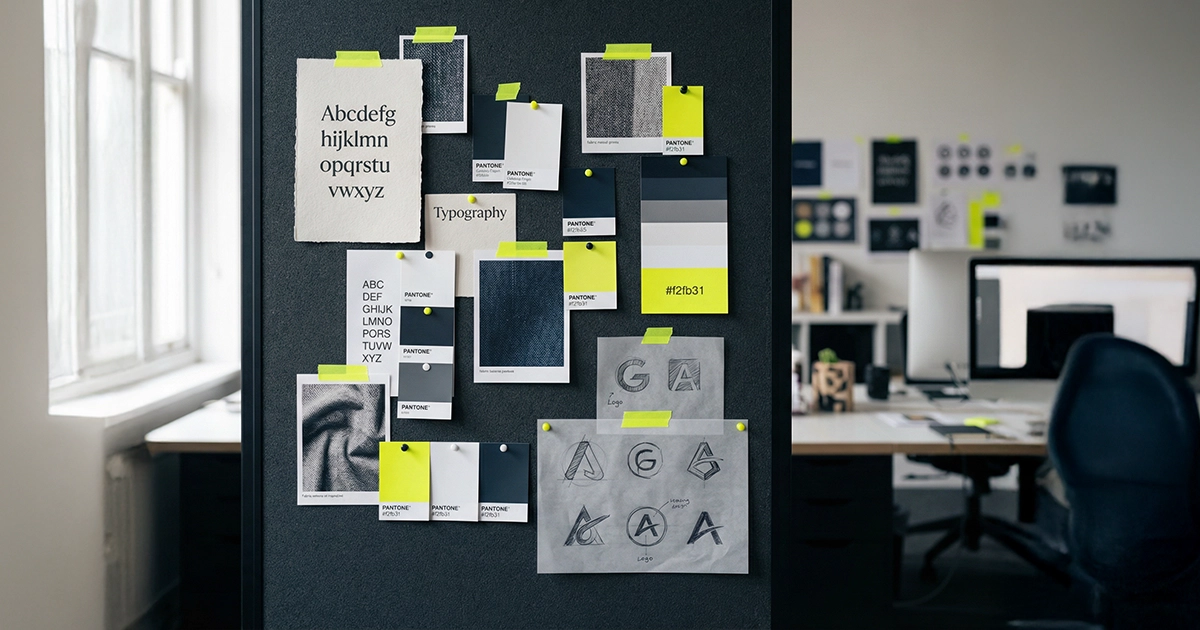
The visual design system is thisvisible faceyour brand. It includes all the graphic elements and rules that ensure your brand appears consistent everywhere.
Logo development
The logo is the central visual element of your brand. A professional logo design includes:
- Primary logo:The main version for most applications
- Secondary logo:A simplified version for small representations
- Image brand:The icon alone, without any lettering
- Protection zone:The minimum distance to other elements
- Minimum size:The smallest representation allowed
Color palette
Colors are the most powerful emotional trigger in visual branding. Your color palette should include:
| Color type | Number | Usage |
|---|---|---|
| Primary colors | 1-2 | Main recognition feature, logo |
| Secondary colors | 2-3 | Complementary accents, backgrounds |
| Neutral colors | 2-4 | Text, backgrounds, gradations |
| Signal colors | 1–2 | CTAs, success/error messages |
Define each color withexact valuesfor all media:
- HEXandRGBfor digital applications
- CMYKfor printed products
- Pantonefor consistent printing colors
- RALfor physical products or interior design
More about the basics ofCorporate designscan be found in our lexicon.
typography
Choosemaximum 2 to 3 font families:
- Headline font:For headings and large texts – can be strong in character
- Body font:For continuous text – must be easy to read
- Accent font (optional):For special emphasis or quotes
Define a clear oneTypography hierarchywith font sizes, line spacing and font weights for each level (H1 to H6, body text, image captions, etc.).
Imagery
Imagery defines what type of photos, illustrations, and graphics your brand uses:
- Photo style:Bright and airy? Dark and dramatic? Authentic and genuine?
- Color treatment:Filters, color corrections, saturation level
- Motives:People? products? Abstract concepts?
- Perspective:Eye level? Bird's eye view? Close-ups?
A consistent visual style ensures your brand is instantly recognizable, even without a logo. Think of brands like Apple or IKEA – their imagery is so unique that you immediately identify them.
If you're looking to revamp your website as a central brand touchpoint, take a look at oursWeb design services.
Create and maintain brand guidelines {#brand-guidelines}
These are brand guidelines (also brand manual or brand book).Rules of your brand. They document all decisions from the previous steps and serve as a reference for anyone working with your brand.
Building a brand book
A complete brand book contains the following chapters:
- Brand story:Why do we exist? What drives us?
- Brand values and positioning:What do we stand for?
- Target groups and personas:Who are we talking to?
- Logo system:All variants, protection zone, minimum size, do's & don'ts
- Color palette:All colors with exact values
- Typography:Fonts, hierarchy, application rules
- Imagery:Photo style, illustrations, icons
- Brand voice:Tonality, word list, text examples
- Application examples:Business cards, stationery, social media, website
- Do's & Don'ts:Clear examples of what is allowed and what is not
Digital brand guidelines
Modern brand guidelines are no longer just a PDF document gathering dust in a drawer. More and more companies are adopting thisdigital brand portals:
- Advantages:Always up to date, searchable, interactive, with download area
- Tools:Frontify, Brandfolder, Bynder or customized solutions
- Access:All employees, external service providers, partners
Let guidelines live
The best brand guidelines are of no use if no one sticks to them. That's why we recommend:
- Brand workshopscarry out for all departments
- Brand championsname in each team
- Regular audits(every 6 months) to check consistency
- Provide templatesfor common use cases
- Feedback processestablish for borderline cases
Rebranding – when and how? {#rebranding}
Not every brand needs a complete rebrand. Sometimes one is enoughBrand refresh(Brand Refresh) to appear relevant and contemporary again. Here are the differences:
| Feature | Brand Refresh | Rebranding |
|---|---|---|
| Scope | Careful modernization | Complete restart |
| Duration | 4-8 weeks | 3-12 months |
| Costs | 3,000-10,000 € | 15,000-50,000+ € |
| Occasion | Outdated design | Strategic change |
| Example | New color nuances, more modern logo | New name, new positioning |
| Risk | Low | High – existing awareness is lost |
When does rebranding make sense?
- HerTarget grouphas changed fundamentally
- HerBusiness modelhas evolved
- There was oneMerger or acquisition
- Your brand image is through acrisisdamaged
- Your brand will be with yououtdated valuesassociated
- They are expanding innew markets(international)
Rebranding process
- Analysis:Why is rebranding necessary? What still works and what doesn't?
- Strategy:New positioning, values, vision
- Creation:New visual system, new voice
- Testing:Testing the reactions of the target group (focus groups)
- Rollout:Step-by-step introduction across all touchpoints
- Communication:Inform customers and partners about the change
A particularly critical point:Choose the right time.Rebranding in the middle of a crisis can be perceived as a diversionary tactic. Plan the relaunch during a period of strength.
Costs of professional brand development {#cost-brand-development}
The costs for brand development vary greatly - depending on the scope, complexity and agency. Here is a realistic overview for youAustrian market:
Cost overview by scope
| Service package | Scope | Costs (net) |
|---|---|---|
| Logo design (logo only) | 3-5 drafts, 2 rounds of revisions | €1,500-3,500 |
| Basic branding | Logo, colors, typography, simple guidelines | €3,000–8,000 |
| Professional branding | All 7 elements, comprehensive guidelines | 8,000–20,000 € |
| Enterprise branding | Multi-brand architecture, digital guidelines | 20,000–50,000+ € |
| Additional: Naming | Name and branding | 2,000–8,000 € |
| Additional: Brand Film | Image film for the brand | 5,000–15,000 € |
What you should pay attention to when creating an offer
- Transparent breakdown:What is included in the price and what costs extra?
- Revision rounds:How many correction loops are included?
- File formats:Do you receive all formats (AI, EPS, SVG, PNG, JPG)?
- Rights of use:Are all rights transferred in full?
- Aftercare:Is there support after the handover?
AtGoldenWingWe offer transparent branding packages that cover all of the points mentioned. From our experience from over120 completed projectsWe know: The investment in a professional brand identity pays for itself within the first 12 months through stronger customer loyalty and higher conversion rates.
ROI of brand development
The return on a brand investment can be determined by several factors:
- Higher prices:Strong brands can, on average13% higher pricesdemand
- Lower acquisition costs:Well-known brands require less advertising budget per new customer
- Better employee recruitment:75% of applicants research the employer brand
- Higher customer loyalty:Emotional brand loyalty increases customer lifetime value
Next Steps
If you are ready to professionally develop or revamp your brand identity, contact us for afree initial consultation. We analyze your current status, discuss your goals and create a tailor-made offer.
In addition to a strong brand identity, we also recommend yoursdigital marketing strategyto check - because the best brand is of no use if it is not visible.
Employer branding: Position your brand as an employer
In times of a shortage of skilled workers - which is particularly noticeable in Austria in the IT, craft and nursing sectors - employer branding becomes a strategic success factor. Your brand identity influences not only how customers perceive you, but also whether the best talent wants to work for you.
What is employer branding?
Employer branding describes the strategic development of an attractive employer brand. It's about communicating your company's values, culture and benefits in a way that potential employees can identify with your brand — even before their first day at work.
According to a study by StepStone Austria, pay attention78% of applicantson the employer brand before they apply. And62%would reject a job offer if the company has a bad reputation as an employer - even with a higher salary.
The connection between brand identity and employer branding
Your brand identity and your employer branding shouldn’t be separate worlds. On the contrary: the strongest employer brands are derived directly from the company brand.
Example from practice:
A Viennese technology company defined its brand values as “innovation, transparency, humanity.” These values were transferred to the employer branding:
- innovation→ Hackathons, 20% free project time, conference budget for each employee
- transparency→ Open salary tables, transparent company figures, regular all-hands meetings
- humanity→ Flexible working hours, mental health support, parental leave program
The result: The application rate increased by 45% within 12 months and the fluctuation rate fell by 30%.
Putting employer branding into practice
1. Define Employee Value Proposition (EVP):
The EVP is the promise to your employees - analogous to the customer promise (Unique Value Proposition). What makes you unique as an employer?
Questions about EVP development:
- Why do your best employees stay with you? (Ask her!)
- What do former employees say about you? (Analyze Kununu reviews)
- What do you offer that the competition doesn't?
- What development opportunities are there?
2. Design career page as a brand experience:
Your career page is the most important touchpoint for potential applicants. You should:
- Represent the company culture authentically (real photos instead of stock images)
- Employee voices and stories included
- Make the application process transparent and simple
- Work flawlessly on mobile devices (over 60% of job searches occur on mobile)
- Load quickly — meet the same performance standards as your main website
3. Use social media for employer branding:
- LinkedIn: Technical contributions from the team, company updates, behind-the-scenes
- Instagram: Team events, office insights, employee spotlights
- Kununu/Glassdoor: Actively respond to reviews, open communication
Employer branding for SMEs: Implement it realistically
You don't have to be Google or Red Bull to build a strong employer brand. SMEs in Austria can also achieve a lot with a manageable budget:
- Maintain Kununu profile: Free, but extremely effective. 70% of all job seekers in Austria use Kununu.
- Create team content: A monthly blog post or LinkedIn post about the team costs next to nothing, but shows personality.
- Communicate benefits: Flexible working hours, the option to work from home or a job ticket - many SMEs offer attractive benefits but do not communicate them.
- Design the onboarding experience: The first day is crucial. Well-thought-out onboarding shows appreciation and is passed on to new employees.
Digital brand management: social media, website and content
Today, digital presence is often the first point of contact between your brand and potential customers. Consistent digital brand management is therefore essential — and requires more than a pretty logo on the website.
The website as the center of the digital brand
Your website is the center of your digital brand identity. Here you have full control over the brand experience — unlike social media platforms, where algorithms and platform design help determine your presentation.
Brand Consistent Website Checklist:
- Color palette: Use your defined brand colors consistently across all pages. Define CSS custom properties (variables) for primary, secondary, accent and neutral colors.
- typography: Maximum of 2 font families — one for headings, one for body text. Load web fonts efficiently via font-display: swap.
- Imagery: Define a clear image style (color filter, image composition, choice of subject) and stick to it on all pages.
- tonality: The text on the website should reflect the defined brand voice — from the main menu to the error page to the cookie banner.
- Micro interactions: Hover effects, loading animations and scrolling behavior are part of the brand experience. Define standards for easing functions, animation durations and interaction patterns.
Social media brand management
Each social media platform has its own culture and usage style. Nevertheless, your brand must remain recognizable. The key is to differentiate betweenconsistentandadaptiveelements.
Consistent elements (same across platforms):
- Logo and profile picture
- Brand colors in graphics and templates
- Core brand messages and values
- Tone of Voice (basic tonality)
Adaptive elements (customized platform-specific):
- Content format (Reels on Instagram, articles on LinkedIn, threads on X)
- Tonality nuances (LinkedIn a little more formal, Instagram a little more personal)
- Hashtag strategy (researched platform-specific)
- Posting frequency (adjusted to platform algorithm)
Content marketing as branding
Content marketing is one of the most effective tools for brand building - especially for service companies and B2B companies. The key: Every piece of content should convey your brand values.
Content formats and their brand impact:
- Blog article: Position yourself as an expert in your field. Don't write about everything, but focus on your core competencies. A web design blog should not write about accounting software.
- Case studies: Show concrete results of your work. Case studies with measurable numbers (e.g. “traffic increase of 230%) build trust and perception of competence.
- White papers and guides: Extensive resources that provide real value position you as a thought leader. In Austria, industry-specific guidelines are particularly effective because the market is clearer than in Germany.
- Video content: Explanatory video, team introduction or customer interview - video conveys personality and emotion better than any other medium.
- Podcasts: Increasingly relevant in the DACH region. An industry podcast positions you as an important voice in your market.
Brand management in email marketing
Email marketing is often overlooked in brand management, but it is one of the most direct communication channels with your target group:
- Newsletter design: Use your brand colors and fonts consistently
- Sender name: Use a recognizable sender name (e.g. "Team GoldenWing" instead of "noreply@domain.at")
- Subject line: Here too, the tonality reflects your brand voice
- signature: Every email from your company is a brand touchpoint. Standardized signatures with logo, contact details and optional advertising banner strengthen brand perception.
Brand strategy for SMEs: practical examples from Austria
Brand development is often viewed as a luxury of large corporations. The reality: A clear brand strategy is a decisive competitive advantage, especially for SMEs in Austria - because it sets them apart from the mass of faceless competitors.
Practical example 1: Craft business in Vienna
Initial situation: A plumbing company with 8 employees in Vienna, 15 years on the market, no recognizable brand. The managing director complained about increasing price pressure from low-cost providers.
Brand strategy:
- positioning: “The installer you can trust” — focus on reliability and quality rather than cheap prices
- Visual system: Professional logo with tool icon, distinctive blue-orange color scheme, uniform workwear with branding
- Digital presence: New website with before and after gallery, Google reviews prominently displayed, local SEO optimization
- Offline branding: Labeled company vehicles (= mobile advertising space), branded protective covers for customer bathrooms, business cards with QR code for the review page
Result after 12 months:
- Inquiries via the website: +120%
- Average order value: +35% (customers choose premium options more often)
- Google reviews: from 12 to 67 (average 4.8 stars)
- Recommendation rate: from 30% to 55%
- Total investment: approx. 8,000 euros (website, logo, vehicle lettering, work clothing)
Practical example 2: Tax consulting firm in Graz
Initial situation: A young law firm with 3 tax advisors, founded in 2021. Difficult to assert itself against established law firms.
Brand strategy:
- positioning: “Tax advice for the digital generation” — focus on digital processes, paperless accounting, start-up advice
- Brand Voice: Approachable and understandable instead of legal and dry. Tax law is explained in simple language.
- Content strategy: Weekly LinkedIn post with tax tips, monthly blog article, quarterly webinar on current tax changes
- Visual system: Modern design with color gradient accents, friendly team photos instead of classic law firm aesthetics
Result after 18 months:
- LinkedIn followers: from 200 to 3,800
- Client inquiries per month: from 5 to 25
- Average age of new clients: 34 years (unusually young in the industry)
- Brand awareness in the Graz start-up scene: 65% unsupported awareness
Practical example 3: Online shop for sustainable fashion
Initial situation: A Salzburg startup with an online shop for fair fashion, 2 founders, bootstrapped without external capital.
Brand strategy:
- positioning: “Fashion with a conscience — without compromising on style.” Clearly against fast fashion, but not didactic.
- Brand values: Transparency (open supply chains), quality (only GOTS-certified materials), community (customers as brand ambassadors)
- Visual identity: Earth tones with a striking mustard yellow accent color, hand-drawn illustrations, recycled wrapping paper with a custom stamp
- Social media: Instagram focus with behind-the-scenes from production facilities, styling tips, UGC (User Generated Content) from the community
Result after 24 months:
- Instagram community: 18,000 followers (organic, without paid ads)
- Repeat purchase rate: 42% (fashion industry average: 25%)
- Average shopping cart: 125 euros (industry average: 85 euros)
- PR mentions: Falter, Der Standard, Woman — without a PR agency, purely through brand awareness
- Total investment in branding: approx. 5,000 euros (logo, packaging design, website design)
Lessons learned: What SMEs can take away from these examples
From these and many other projects we have identified the following success patterns:
- Clear positioning suggests a broad offering: The more specific your positioning, the stronger the brand. “We do everything for everyone” is not a positioning.
- Consistency across all touchpoints: The strongest SMB brands are not the ones with the biggest budgets, but the ones with the most consistency — from Google profile to website to email signature.
- Authenticity over perfection: SMEs have a natural advantage over corporations: personality. Use these. Real team photos have a stronger impact than perfect stock images.
- Live brand values, not just communicate them: The law firm that preaches “digital” but sends invoices by mail has a credibility problem.
Brand measurement: KPIs and tools for your brand success
“If you can’t measure it, you can’t manage it” — this Peter Drucker quote also applies to brand management. But how do you measure something as abstract as a brand? With the right KPIs and tools, this is possible more precisely than many people think.
Quantitative brand KPIs
1. Brand awareness:
- Supported awareness: "Do you know brand X?" — measurable via online surveys (e.g. via Google Surveys or Typeform)
- Unsupported notoriety: "Which brands do you know in category X?" — more meaningful, but harder to measure
- Branded Search Volume: How often is your brand name searched on Google? Increasing branded searches are a strong signal of growing awareness. Measurable via Google Search Console or Google Trends.
2. Brand perception:
- Net Promoter Score (NPS): “How likely are you to recommend us?” (0-10 scale). An NPS over 50 is considered excellent.
- Kununu/Google Reviews: Average star rating and sentiment analysis of the review texts
- Social sentiment: Ratio of positive to negative mentions on social media. Tools like Brandwatch or Mention help with automated analysis.
3. Brand Loyalty:
- Repurchase rate: How many customers buy from you again?
- Customer Lifetime Value (CLV): How much sales does a customer generate over the entire business relationship?
- Share of wallet: What proportion of spending in your category does a customer spend with you?
Free and cheap measuring tools
You don't need a six-figure market research budget to measure your brand:
- Google Search Console(free): Branded search queries, impressions and click rates for your brand name
- Google Trends(free): Development of search interest in your brand over time, comparison with competitors
- Google Alerts(Free): Get alerts for new mentions of your brand name on the web
- Social media analytics(free): Reach, engagement and follower growth on your channels
- Typeform/Google Forms(free/cheap): Customer surveys on brand values and NPS
- Hotjar(Freemium): User behavior on your website — how do visitors interact with your brand?
Brand tracking: Measure and evaluate regularly
A one-time measurement is of little use - the value lies in tracking over time. We recommend the following measuring interval:
Monthly:
- Branded Search Volume (Google Search Console)
- Social media metrics (followers, engagement, reach)
- Website traffic from direct access (= brand awareness)
- New Google reviews and average value
Quarterly:
- NPS survey (can be set up as an automated email survey after each project completion)
- Competitive benchmark (how does your visibility compare?)
- Content performance (which content strengthens brand perception the most?)
Yearly:
- Comprehensive brand survey (supported and unsupported awareness, brand image dimensions)
- Brand Audit (checking all touchpoints for consistency)
- Strategy review (is the positioning still correct? Have the market or target group changed?)
Calculate brand ROI
The ultimate question: What are you getting out of your brand investment? The calculation is not trivial, but possible:
Direct brand effects:
- Price premium: Can you charge more than no-name competitors? (Compare your average prices with the industry average)
- Acquisition costs: Do your costs per new customer decrease over time? (Strong brands have lower CAC)
- Conversion rate: Do visitors convert more often because they know and trust your brand?
Indirect brand effects:
- Recruiting employees: Can you fill positions faster and cheaper?
- Negotiating position: Do you have a stronger negotiating position with partners and suppliers?
- Crisis resistance: Does your brand survive setbacks better than unknown competitors?
A rule of thumb from our experience: Every euro invested in consistent brand management generates an ROI of 300-700% over 3-5 years - provided the brand strategy is sound and the implementation is consistent.
Employer branding: Position your brand as an employer
In times of a shortage of skilled workers - which is particularly noticeable in Austria in the IT, craft and nursing sectors - employer branding becomes a strategic success factor. Your brand identity influences not only how customers perceive you, but also whether the best talent wants to work for you.
What is employer branding?
Employer branding describes the strategic development of an attractive employer brand. It's about communicating your company's values, culture and benefits in a way that potential employees can identify with your brand — even before their first day at work.
According to a study by StepStone Austria, pay attention78% of applicantson the employer brand before they apply. And62%would reject a job offer if the company has a bad reputation as an employer - even with a higher salary.
The connection between brand identity and employer branding
Your brand identity and your employer branding shouldn’t be separate worlds. On the contrary: the strongest employer brands are derived directly from the company brand.
Example from practice:
A Viennese technology company defined its brand values as “innovation, transparency, humanity.” These values were transferred to the employer branding:
- innovation→ Hackathons, 20% free project time, conference budget for each employee
- transparency→ Open salary tables, transparent company figures, regular all-hands meetings
- humanity→ Flexible working hours, mental health support, parental leave program
The result: The application rate increased by 45% within 12 months and the fluctuation rate fell by 30%.
Putting employer branding into practice
1. Define Employee Value Proposition (EVP):
The EVP is the promise to your employees - analogous to the customer promise (Unique Value Proposition). What makes you unique as an employer?
Questions about EVP development:
- Why do your best employees stay with you? (Ask her!)
- What do former employees say about you? (Analyze Kununu reviews)
- What do you offer that the competition doesn't?
- What development opportunities are there?
2. Design career page as a brand experience:
Your career page is the most important touchpoint for potential applicants. You should:
- Represent the company culture authentically (real photos instead of stock images)
- Employee voices and stories included
- Make the application process transparent and simple
- Work flawlessly on mobile devices (over 60% of job searches occur on mobile)
- Load quickly — meet the same performance standards as your main website
3. Use social media for employer branding:
- LinkedIn: Technical contributions from the team, company updates, behind-the-scenes
- Instagram: Team events, office insights, employee spotlights
- Kununu/Glassdoor: Actively respond to reviews, open communication
Employer branding for SMEs: Implement it realistically
You don't have to be Google or Red Bull to build a strong employer brand. SMEs in Austria can also achieve a lot with a manageable budget:
- Maintain Kununu profile: Free, but extremely effective. 70% of all job seekers in Austria use Kununu.
- Create team content: A monthly blog post or LinkedIn post about the team costs next to nothing, but shows personality.
- Communicate benefits: Flexible working hours, the option to work from home or a job ticket - many SMEs offer attractive benefits but do not communicate them.
- Design the onboarding experience: The first day is crucial. Well-thought-out onboarding shows appreciation and is passed on to new employees.
Digital brand management: social media, website and content
Today, digital presence is often the first point of contact between your brand and potential customers. Consistent digital brand management is therefore essential — and requires more than a pretty logo on the website.
The website as the center of the digital brand
Your website is the center of your digital brand identity. Here you have full control over the brand experience — unlike social media platforms, where algorithms and platform design help determine your presentation.
Brand Consistent Website Checklist:
- Color palette: Use your defined brand colors consistently across all pages. Define CSS custom properties (variables) for primary, secondary, accent and neutral colors.
- typography: Maximum of 2 font families — one for headings, one for body text. Load web fonts efficiently via font-display: swap.
- Imagery: Define a clear image style (color filter, image composition, choice of subject) and stick to it on all pages.
- tonality: The text on the website should reflect the defined brand voice — from the main menu to the error page to the cookie banner.
- Micro interactions: Hover effects, loading animations and scrolling behavior are part of the brand experience. Define standards for easing functions, animation durations and interaction patterns.
Social media brand management
Each social media platform has its own culture and usage style. Nevertheless, your brand must remain recognizable. The key is to differentiate betweenconsistentandadaptiveelements.
Consistent elements (same across platforms):
- Logo and profile picture
- Brand colors in graphics and templates
- Core brand messages and values
- Tone of Voice (basic tonality)
Adaptive elements (customized platform-specific):
- Content format (Reels on Instagram, articles on LinkedIn, threads on X)
- Tonality nuances (LinkedIn a little more formal, Instagram a little more personal)
- Hashtag strategy (researched platform-specific)
- Posting frequency (adjusted to platform algorithm)
Content marketing as branding
Content marketing is one of the most effective tools for brand building - especially for service companies and B2B companies. The key: Every piece of content should convey your brand values.
Content formats and their brand impact:
- Blog article: Position yourself as an expert in your field. Don't write about everything, but focus on your core competencies. A web design blog should not write about accounting software.
- Case studies: Show concrete results of your work. Case studies with measurable numbers (e.g. “traffic increase of 230%) build trust and perception of competence.
- White papers and guides: Extensive resources that provide real value position you as a thought leader. In Austria, industry-specific guidelines are particularly effective because the market is clearer than in Germany.
- Video content: Explanatory video, team introduction or customer interview - video conveys personality and emotion better than any other medium.
- Podcasts: Increasingly relevant in the DACH region. An industry podcast positions you as an important voice in your market.
Brand management in email marketing
Email marketing is often overlooked in brand management, but it is one of the most direct communication channels with your target group:
- Newsletter design: Use your brand colors and fonts consistently
- Sender name: Use a recognizable sender name (e.g. "Team GoldenWing" instead of "noreply@domain.at")
- Subject line: Here too, the tonality reflects your brand voice
- signature: Every email from your company is a brand touchpoint. Standardized signatures with logo, contact details and optional advertising banner strengthen brand perception.
Brand strategy for SMEs: practical examples from Austria
Brand development is often viewed as a luxury of large corporations. The reality: A clear brand strategy is a decisive competitive advantage, especially for SMEs in Austria - because it sets them apart from the mass of faceless competitors.
Practical example 1: Craft business in Vienna
Initial situation: A plumbing company with 8 employees in Vienna, 15 years on the market, no recognizable brand. The managing director complained about increasing price pressure from low-cost providers.
Brand strategy:
- positioning: “The installer you can trust” — focus on reliability and quality rather than cheap prices
- Visual system: Professional logo with tool icon, distinctive blue-orange color scheme, uniform workwear with branding
- Digital presence: New website with before and after gallery, Google reviews prominently displayed, local SEO optimization
- Offline branding: Labeled company vehicles (= mobile advertising space), branded protective covers for customer bathrooms, business cards with QR code for the review page
Result after 12 months:
- Inquiries via the website: +120%
- Average order value: +35% (customers choose premium options more often)
- Google reviews: from 12 to 67 (average 4.8 stars)
- Recommendation rate: from 30% to 55%
- Total investment: approx. 8,000 euros (website, logo, vehicle lettering, work clothing)
Practical example 2: Tax consulting firm in Graz
Initial situation: A young law firm with 3 tax advisors, founded in 2021. Difficult to assert itself against established law firms.
Brand strategy:
- positioning: “Tax advice for the digital generation” — focus on digital processes, paperless accounting, start-up advice
- Brand Voice: Approachable and understandable instead of legal and dry. Tax law is explained in simple language.
- Content strategy: Weekly LinkedIn post with tax tips, monthly blog article, quarterly webinar on current tax changes
- Visual system: Modern design with color gradient accents, friendly team photos instead of classic law firm aesthetics
Result after 18 months:
- LinkedIn followers: from 200 to 3,800
- Client inquiries per month: from 5 to 25
- Average age of new clients: 34 years (unusually young in the industry)
- Brand awareness in the Graz start-up scene: 65% unsupported awareness
Practical example 3: Online shop for sustainable fashion
Initial situation: A Salzburg startup with an online shop for fair fashion, 2 founders, bootstrapped without external capital.
Brand strategy:
- positioning: “Fashion with a conscience — without compromising on style.” Clearly against fast fashion, but not didactic.
- Brand values: Transparency (open supply chains), quality (only GOTS-certified materials), community (customers as brand ambassadors)
- Visual identity: Earth tones with a striking mustard yellow accent color, hand-drawn illustrations, recycled wrapping paper with a custom stamp
- Social media: Instagram focus with behind-the-scenes from production facilities, styling tips, UGC (User Generated Content) from the community
Result after 24 months:
- Instagram community: 18,000 followers (organic, without paid ads)
- Repeat purchase rate: 42% (fashion industry average: 25%)
- Average shopping cart: 125 euros (industry average: 85 euros)
- PR mentions: Falter, Der Standard, Woman — without a PR agency, purely through brand awareness
- Total investment in branding: approx. 5,000 euros (logo, packaging design, website design)
Lessons learned: What SMEs can take away from these examples
From these and many other projects we have identified the following success patterns:
- Clear positioning suggests a broad offering: The more specific your positioning, the stronger the brand. “We do everything for everyone” is not a positioning.
- Consistency across all touchpoints: The strongest SMB brands are not the ones with the biggest budgets, but the ones with the most consistency — from Google profile to website to email signature.
- Authenticity over perfection: SMEs have a natural advantage over corporations: personality. Use these. Real team photos have a stronger impact than perfect stock images.
- Live brand values, not just communicate them: The law firm that preaches “digital” but sends invoices by mail has a credibility problem.
Brand measurement: KPIs and tools for your brand success
“If you can’t measure it, you can’t manage it” — this Peter Drucker quote also applies to brand management. But how do you measure something as abstract as a brand? With the right KPIs and tools, this is possible more precisely than many people think.
Quantitative brand KPIs
1. Brand awareness:
- Supported awareness: "Do you know brand X?" — measurable via online surveys (e.g. via Google Surveys or Typeform)
- Unsupported notoriety: "Which brands do you know in category X?" — more meaningful, but harder to measure
- Branded Search Volume: How often is your brand name searched on Google? Increasing branded searches are a strong signal of growing awareness. Measurable via Google Search Console or Google Trends.
2. Brand perception:
- Net Promoter Score (NPS): “How likely are you to recommend us?” (0-10 scale). An NPS over 50 is considered excellent.
- Kununu/Google Reviews: Average star rating and sentiment analysis of the review texts
- Social sentiment: Ratio of positive to negative mentions on social media. Tools like Brandwatch or Mention help with automated analysis.
3. Brand Loyalty:
- Repurchase rate: How many customers buy from you again?
- Customer Lifetime Value (CLV): How much sales does a customer generate over the entire business relationship?
- Share of wallet: What proportion of spending in your category does a customer spend with you?
Free and cheap measuring tools
You don't need a six-figure market research budget to measure your brand:
- Google Search Console(free): Branded search queries, impressions and click rates for your brand name
- Google Trends(free): Development of search interest in your brand over time, comparison with competitors
- Google Alerts(Free): Get alerts for new mentions of your brand name on the web
- Social media analytics(free): Reach, engagement and follower growth on your channels
- Typeform/Google Forms(free/cheap): Customer surveys on brand values and NPS
- Hotjar(Freemium): User behavior on your website — how do visitors interact with your brand?
Brand tracking: Measure and evaluate regularly
A one-time measurement is of little use - the value lies in tracking over time. We recommend the following measuring interval:
Monthly:
- Branded Search Volume (Google Search Console)
- Social media metrics (followers, engagement, reach)
- Website traffic from direct access (= brand awareness)
- New Google reviews and average value
Quarterly:
- NPS survey (can be set up as an automated email survey after each project completion)
- Competitive benchmark (how does your visibility compare?)
- Content performance (which content strengthens brand perception the most?)
Yearly:
- Comprehensive brand survey (supported and unsupported awareness, brand image dimensions)
- Brand Audit (checking all touchpoints for consistency)
- Strategy review (is the positioning still correct? Have the market or target group changed?)
Calculate brand ROI
The ultimate question: What are you getting out of your brand investment? The calculation is not trivial, but possible:
Direct brand effects:
- Price premium: Can you charge more than no-name competitors? (Compare your average prices with the industry average)
- Acquisition costs: Do your costs per new customer decrease over time? (Strong brands have lower CAC)
- Conversion rate: Do visitors convert more often because they know and trust your brand?
Indirect brand effects:
- Recruiting employees: Can you fill positions faster and cheaper?
- Negotiating position: Do you have a stronger negotiating position with partners and suppliers?
- Crisis resistance: Does your brand survive setbacks better than unknown competitors?
A rule of thumb from our experience: Every euro invested in consistent brand management generates an ROI of 300-700% over 3-5 years - provided the brand strategy is sound and the implementation is consistent.
Brand architecture: individual, family and umbrella brand strategies
As soon as a company offers more than one product or service, the question arises as to the optimal brand architecture. The decision between single brand, family brand and umbrella brand strategy has far-reaching implications for brand perception, marketing budget and long-term scalability. For companies in the DACH region, where medium-sized businesses form the backbone of the economy, well-thought-out brand architecture is a decisive competitive advantage.
The three basic models of brand architecture
Each model has specific advantages and disadvantages that vary depending on company size, industry and growth strategy.
Single brand strategy (House of Brands)
With the single brand strategy, each product or service has its own brand with its own name, logo and visual identity. The umbrella brand fades into the background or is invisible to end customers.
- Advantages: Maximum flexibility in positioning, no risk of negative brand transfer, possibility to specifically address different target groups
- Disadvantages: High marketing costs because each brand has to be built individually, no synergy effects in brand awareness
- Suitable for: Companies with very different target groups and product categories
- ROOF example: Henkel with Persil, Pritt, Schwarzkopf - each brand stands for itself
Family brand strategy (Endorsed Brands)
The family brand strategy groups related products under a common brand, with the umbrella brand visible as a guarantee of quality. The individual products or services have their own names, but are clearly assigned to the umbrella brand.
- Advantages: Synergy effects through the common umbrella brand, transfer of trust to new products, moderate marketing costs
- Disadvantages: Limited positioning options, risk of brand dilution with too many sub-brands
- Suitable for: Medium-sized companies with related product lines
- ROOF example: Raiffeisen with Raiffeisen Bank, Raiffeisen Leasing, Raiffeisen Capital
Umbrella brand strategy (Branded House)
With the umbrella brand strategy, all products and services appear under a single brand. There are no sub-brands — the umbrella brand is the only brand.
- Advantages: Maximum synergy effects, lowest marketing costs, strong, uniform brand perception
- Disadvantages: High risk in the event of brand crises (affects all products), difficult with very different target groups
- Suitable for: Companies with a homogeneous offering and a uniform target group
- ROOF example: Red Bull — all products and activities run under the umbrella brand
Hybrid brand architectures
In practice, most successful companies in the DACH region use ithybrid models, which combine elements of different strategies. According to oneStudy by the Vienna University of Economics and Business67% of the top 500 Austrian companies rely on hybrid brand architectures.
A typical hybrid model for a medium-sized company could look like this:
- Umbrella brandfor corporate identity and B2B communication
- Family brandsfor the different business areas
- Individual brandsfor flagship products or special market segments
Brand Architecture Decision: A Framework
Choosing the right brand architecture depends on several factors. Use the following evaluation scheme:
- Target group homogeneity— The more similar your target groups are, the more suitable an umbrella brand strategy is
- Product relatedness— Closely related products benefit from a family brand, while completely different products require individual brands
- Brand value of the umbrella brand— Is your umbrella brand already well-known and positively viewed? Then use this advantage with a branded house strategy
- Growth strategy— Are you planning acquisitions? Then a flexible house-of-brands strategy is advantageous
- Budget constraints— With a limited budget, an umbrella brand strategy is often the only viable option
Migration of brand architecture
Converting an existing brand architecture is a complex undertaking that is average in the DACH region18-36 monthslasts. Typical scenarios are:
- Consolidation— After acquisitions, individual brands are brought under one umbrella brand (e.g. after a company takeover)
- Diversification— Individual brands are spun off from an umbrella brand in order to open up new markets
- Restructuring— The existing architecture is adapted to a changed corporate strategy
The key to success lies ingradual migrationwith clear communication to all stakeholders. An abrupt change can lead to a significant loss of brand value.
Brand and Sustainability: Purpose-Driven Branding
Sustainability is no longer a niche topic - it has become a central element of the brand identity. Companies in the DACH region that integrate an authentic sustainability purpose into their brand benefit from higher customer loyalty, better employer attractiveness and stronger long-term brand value. At the same time, the topic carries risks:Greenwashingis quickly recognized by critical consumers and can cause lasting damage to a brand.
The DACH market and sustainability
The importance of sustainability for purchasing decisions in the DACH region has increased significantly in recent years:
- 79%of Austrian consumers say that sustainability influences their purchasing decisions (Austrian Sustainability Monitor 2025)
- 64%are willing to pay a premium of up to 15% for sustainable products
- 52%have changed a brand in the last 12 months due to a lack of sustainability
- 83%Generation Z in Austria expect companies to take a clear stance on environmental and social issues
These numbers show:Sustainability is not a nice-to-have, but a business imperative.Companies that ignore this trend risk their long-term competitiveness.
Purpose-Driven Branding: More than marketing
A sustainable brand purpose goes far beyond marketing messages. It must be lived throughout the entire company — from the supply chain to production to customer service. The most successful purpose-driven brands in the DACH region are characterized by the following features:
Authenticity:
- The purpose is anchored in the company’s history or founding values
- Sustainability goals are measurable and verifiable
- Progress and setbacks are communicated transparently
- Employees are actively involved in sustainability initiatives
Consistency:
- The purpose penetrates all brand touchpoints - from the website to the packaging to the customer conversation
- Marketing claims match actual company actions
- Even uncomfortable decisions are made in accordance with the purpose
Relevance:
- The purpose addresses a topic that is actually important to the target group
- It offers a concrete contribution to solving a social or ecological problem
- It differentiates the brand from the competition
Sustainability communication: dos and don'ts
Communicating sustainability issues is a balancing act. In the DACH region, consumers are particularly critical and well informed.
DOS:
- Concrete numbers and factsinstead of vague promises (“We have reduced our CO2 emissions by 34%” instead of “We are committed to sustainability”)
- Independent certificationsuse (B Corp, Blue Angel, Austria Bio Guarantee, Common Good Economy)
- The entire value chaininclude — not just the end product, but also suppliers and logistics
- Storytelling with real protagonists— Show the people behind your sustainability initiatives
- Progress reportspublish — Regular updates show that sustainability is not a one-time project
Don'ts:
- Greenwashing— Exaggerated or misleading environmental claims. In the DACH region, there is an increasing threat of legal consequences from the EU Green Claims Directive
- Cherry picking— Only communicate positive aspects and hide problematic ones
- Buzzwords without substance— “Climate neutral”, “environmentally friendly” or “green” without any evidence or explanation
- Red herring— Highlight small sustainability initiatives to distract from larger issues
Sustainability as a differentiating factor
For companies in the DACH region, sustainability offers a unique opportunity for differentiation. In many industries, products and services have become interchangeable - the purpose can make the crucial difference.
Strategies for differentiation through sustainability:
- Circular economy— Design products to be repairable, reusable and recyclable
- Local value creation— Position production in Austria or the EU as a quality and sustainability feature
- Social sustainability— Fair working conditions, diversity and social commitment as brand values
- transparency— Open communication about supply chains, production conditions and environmental impacts
- Education and empowerment— Support customers to act more sustainably themselves
Measuring the sustainability impact on the brand
To quantify the contribution of sustainability to brand identity, you should collect the following metrics:
- Brand Purpose Score— Measures how strongly consumers associate your brand with a clear purpose
- Net Promoter Score (NPS)— Segmented by sustainability-conscious and less-conscious customers
- Share of voicein sustainability issues — How present is your brand in the public sustainability discussion?
- Employer branding metrics— Applicant numbers and quality, employee retention among talents with an affinity for sustainability
- Price premium— What premium can you achieve compared to non-sustainable competitors?
- Customer Lifetime Value— Do sustainability-conscious customers buy more often and stay loyal longer?
OneLong-term study by the University of St. Gallenshows that companies with an authentic sustainability purpose increase their brand value on average over a period of 5 yearsIncrease 28% morethan comparable companies without a clear purpose. For SMEs in the DACH region, this is a strong argument not to view sustainability as a cost factor, but rather as a strategic investment in the brand identity.
Employer branding: Position your brand as an employer
In times of a shortage of skilled workers - which is particularly noticeable in Austria in the IT, craft and nursing sectors - employer branding becomes a strategic success factor. Your brand identity influences not only how customers perceive you, but also whether the best talent wants to work for you.
What is employer branding?
Employer branding describes the strategic development of an attractive employer brand. It's about communicating your company's values, culture and benefits in a way that potential employees can identify with your brand — even before their first day at work.
According to a study by StepStone Austria, pay attention78% of applicantson the employer brand before they apply. And62%would reject a job offer if the company has a bad reputation as an employer - even with a higher salary.
The connection between brand identity and employer branding
Your brand identity and your employer branding shouldn’t be separate worlds. On the contrary: the strongest employer brands are derived directly from the company brand.
Example from practice:
A Viennese technology company defined its brand values as “innovation, transparency, humanity.” These values were transferred to the employer branding:
- innovation→ Hackathons, 20% free project time, conference budget for each employee
- transparency→ Open salary tables, transparent company figures, regular all-hands meetings
- humanity→ Flexible working hours, mental health support, parental leave program
The result: The application rate increased by 45% within 12 months and the fluctuation rate fell by 30%.
Putting employer branding into practice
1. Define Employee Value Proposition (EVP):
The EVP is the promise to your employees - analogous to the customer promise (Unique Value Proposition). What makes you unique as an employer?
Questions about EVP development:
- Why do your best employees stay with you? (Ask her!)
- What do former employees say about you? (Analyze Kununu reviews)
- What do you offer that the competition doesn't?
- What development opportunities are there?
2. Design career page as a brand experience:
Your career page is the most important touchpoint for potential applicants. You should:
- Represent the company culture authentically (real photos instead of stock images)
- Employee voices and stories included
- Make the application process transparent and simple
- Work flawlessly on mobile devices (over 60% of job searches occur on mobile)
- Load quickly — meet the same performance standards as your main website
3. Use social media for employer branding:
- LinkedIn: Technical contributions from the team, company updates, behind-the-scenes
- Instagram: Team events, office insights, employee spotlights
- Kununu/Glassdoor: Actively respond to reviews, open communication
Employer branding for SMEs: Implement it realistically
You don't have to be Google or Red Bull to build a strong employer brand. SMEs in Austria can also achieve a lot with a manageable budget:
- Maintain Kununu profile: Free, but extremely effective. 70% of all job seekers in Austria use Kununu.
- Create team content: A monthly blog post or LinkedIn post about the team costs next to nothing, but shows personality.
- Communicate benefits: Flexible working hours, the option to work from home or a job ticket - many SMEs offer attractive benefits but do not communicate them.
- Design the onboarding experience: The first day is crucial. Well-thought-out onboarding shows appreciation and is passed on to new employees.
Digital brand management: social media, website and content
Today, digital presence is often the first point of contact between your brand and potential customers. Consistent digital brand management is therefore essential — and requires more than a pretty logo on the website.
The website as the center of the digital brand
Your website is the center of your digital brand identity. Here you have full control over the brand experience — unlike social media platforms, where algorithms and platform design help determine your presentation.
Brand Consistent Website Checklist:
- Color palette: Use your defined brand colors consistently across all pages. Define CSS custom properties (variables) for primary, secondary, accent and neutral colors.
- typography: Maximum of 2 font families — one for headings, one for body text. Load web fonts efficiently via font-display: swap.
- Imagery: Define a clear image style (color filter, image composition, choice of subject) and stick to it on all pages.
- tonality: The text on the website should reflect the defined brand voice — from the main menu to the error page to the cookie banner.
- Micro interactions: Hover effects, loading animations and scrolling behavior are part of the brand experience. Define standards for easing functions, animation durations and interaction patterns.
Social media brand management
Each social media platform has its own culture and usage style. Nevertheless, your brand must remain recognizable. The key is to differentiate betweenconsistentandadaptiveelements.
Consistent elements (same across platforms):
- Logo and profile picture
- Brand colors in graphics and templates
- Core brand messages and values
- Tone of Voice (basic tonality)
Adaptive elements (customized platform-specific):
- Content format (Reels on Instagram, articles on LinkedIn, threads on X)
- Tonality nuances (LinkedIn a little more formal, Instagram a little more personal)
- Hashtag strategy (researched platform-specific)
- Posting frequency (adjusted to platform algorithm)
Content marketing as branding
Content marketing is one of the most effective tools for brand building - especially for service companies and B2B companies. The key: Every piece of content should convey your brand values.
Content formats and their brand impact:
- Blog article: Position yourself as an expert in your field. Don't write about everything, but focus on your core competencies. A web design blog should not write about accounting software.
- Case studies: Show concrete results of your work. Case studies with measurable numbers (e.g. “traffic increase of 230%) build trust and perception of competence.
- White papers and guides: Extensive resources that provide real value position you as a thought leader. In Austria, industry-specific guidelines are particularly effective because the market is clearer than in Germany.
- Video content: Explanatory video, team introduction or customer interview - video conveys personality and emotion better than any other medium.
- Podcasts: Increasingly relevant in the DACH region. An industry podcast positions you as an important voice in your market.
Brand management in email marketing
Email marketing is often overlooked in brand management, but it is one of the most direct communication channels with your target group:
- Newsletter design: Use your brand colors and fonts consistently
- Sender name: Use a recognizable sender name (e.g. "Team GoldenWing" instead of "noreply@domain.at")
- Subject line: Here too, the tonality reflects your brand voice
- signature: Every email from your company is a brand touchpoint. Standardized signatures with logo, contact details and optional advertising banner strengthen brand perception.
Brand strategy for SMEs: practical examples from Austria
Brand development is often viewed as a luxury of large corporations. The reality: A clear brand strategy is a decisive competitive advantage, especially for SMEs in Austria - because it sets them apart from the mass of faceless competitors.
Practical example 1: Craft business in Vienna
Initial situation: A plumbing company with 8 employees in Vienna, 15 years on the market, no recognizable brand. The managing director complained about increasing price pressure from low-cost providers.
Brand strategy:
- positioning: “The installer you can trust” — focus on reliability and quality rather than cheap prices
- Visual system: Professional logo with tool icon, distinctive blue-orange color scheme, uniform workwear with branding
- Digital presence: New website with before and after gallery, Google reviews prominently displayed, local SEO optimization
- Offline branding: Labeled company vehicles (= mobile advertising space), branded protective covers for customer bathrooms, business cards with QR code for the review page
Result after 12 months:
- Inquiries via the website: +120%
- Average order value: +35% (customers choose premium options more often)
- Google reviews: from 12 to 67 (average 4.8 stars)
- Recommendation rate: from 30% to 55%
- Total investment: approx. 8,000 euros (website, logo, vehicle lettering, work clothing)
Practical example 2: Tax consulting firm in Graz
Initial situation: A young law firm with 3 tax advisors, founded in 2021. Difficult to assert itself against established law firms.
Brand strategy:
- positioning: “Tax advice for the digital generation” — focus on digital processes, paperless accounting, start-up advice
- Brand Voice: Approachable and understandable instead of legal and dry. Tax law is explained in simple language.
- Content strategy: Weekly LinkedIn post with tax tips, monthly blog article, quarterly webinar on current tax changes
- Visual system: Modern design with color gradient accents, friendly team photos instead of classic law firm aesthetics
Result after 18 months:
- LinkedIn followers: from 200 to 3,800
- Client inquiries per month: from 5 to 25
- Average age of new clients: 34 years (unusually young in the industry)
- Brand awareness in the Graz start-up scene: 65% unsupported awareness
Practical example 3: Online shop for sustainable fashion
Initial situation: A Salzburg startup with an online shop for fair fashion, 2 founders, bootstrapped without external capital.
Brand strategy:
- positioning: “Fashion with a conscience — without compromising on style.” Clearly against fast fashion, but not didactic.
- Brand values: Transparency (open supply chains), quality (only GOTS-certified materials), community (customers as brand ambassadors)
- Visual identity: Earth tones with a striking mustard yellow accent color, hand-drawn illustrations, recycled wrapping paper with a custom stamp
- Social media: Instagram focus with behind-the-scenes from production facilities, styling tips, UGC (User Generated Content) from the community
Result after 24 months:
- Instagram community: 18,000 followers (organic, without paid ads)
- Repeat purchase rate: 42% (fashion industry average: 25%)
- Average shopping cart: 125 euros (industry average: 85 euros)
- PR mentions: Falter, Der Standard, Woman — without a PR agency, purely through brand awareness
- Total investment in branding: approx. 5,000 euros (logo, packaging design, website design)
Lessons learned: What SMEs can take away from these examples
From these and many other projects we have identified the following success patterns:
- Clear positioning suggests a broad offering: The more specific your positioning, the stronger the brand. “We do everything for everyone” is not a positioning.
- Consistency across all touchpoints: The strongest SMB brands are not the ones with the biggest budgets, but the ones with the most consistency — from Google profile to website to email signature.
- Authenticity over perfection: SMEs have a natural advantage over corporations: personality. Use these. Real team photos have a stronger impact than perfect stock images.
- Live brand values, not just communicate them: The law firm that preaches “digital” but sends invoices by mail has a credibility problem.
Brand measurement: KPIs and tools for your brand success
“If you can’t measure it, you can’t manage it” — this Peter Drucker quote also applies to brand management. But how do you measure something as abstract as a brand? With the right KPIs and tools, this is possible more precisely than many people think.
Quantitative brand KPIs
1. Brand awareness:
- Supported awareness: "Do you know brand X?" — measurable via online surveys (e.g. via Google Surveys or Typeform)
- Unsupported notoriety: "Which brands do you know in category X?" — more meaningful, but harder to measure
- Branded Search Volume: How often is your brand name searched on Google? Increasing branded searches are a strong signal of growing awareness. Measurable via Google Search Console or Google Trends.
2. Brand perception:
- Net Promoter Score (NPS): “How likely are you to recommend us?” (0-10 scale). An NPS over 50 is considered excellent.
- Kununu/Google Reviews: Average star rating and sentiment analysis of the review texts
- Social sentiment: Ratio of positive to negative mentions on social media. Tools like Brandwatch or Mention help with automated analysis.
3. Brand Loyalty:
- Repurchase rate: How many customers buy from you again?
- Customer Lifetime Value (CLV): How much sales does a customer generate over the entire business relationship?
- Share of wallet: What proportion of spending in your category does a customer spend with you?
Free and cheap measuring tools
You don't need a six-figure market research budget to measure your brand:
- Google Search Console(free): Branded search queries, impressions and click rates for your brand name
- Google Trends(free): Development of search interest in your brand over time, comparison with competitors
- Google Alerts(Free): Get alerts for new mentions of your brand name on the web
- Social media analytics(free): Reach, engagement and follower growth on your channels
- Typeform/Google Forms(free/cheap): Customer surveys on brand values and NPS
- Hotjar(Freemium): User behavior on your website — how do visitors interact with your brand?
Brand tracking: Measure and evaluate regularly
A one-time measurement is of little use - the value lies in tracking over time. We recommend the following measuring interval:
Monthly:
- Branded Search Volume (Google Search Console)
- Social media metrics (followers, engagement, reach)
- Website traffic from direct access (= brand awareness)
- New Google reviews and average value
Quarterly:
- NPS survey (can be set up as an automated email survey after each project completion)
- Competitive benchmark (how does your visibility compare?)
- Content performance (which content strengthens brand perception the most?)
Yearly:
- Comprehensive brand survey (supported and unsupported awareness, brand image dimensions)
- Brand Audit (checking all touchpoints for consistency)
- Strategy review (is the positioning still correct? Have the market or target group changed?)
Calculate brand ROI
The ultimate question: What are you getting out of your brand investment? The calculation is not trivial, but possible:
Direct brand effects:
- Price premium: Can you charge more than no-name competitors? (Compare your average prices with the industry average)
- Acquisition costs: Do your costs per new customer decrease over time? (Strong brands have lower CAC)
- Conversion rate: Do visitors convert more often because they know and trust your brand?
Indirect brand effects:
- Recruiting employees: Can you fill positions faster and cheaper?
- Negotiating position: Do you have a stronger negotiating position with partners and suppliers?
- Crisis resistance: Does your brand survive setbacks better than unknown competitors?
A rule of thumb from our experience: Every euro invested in consistent brand management generates an ROI of 300-700% over 3-5 years - provided the brand strategy is sound and the implementation is consistent.
Brand architecture: individual, family and umbrella brand strategies
As soon as a company offers more than one product or service, the question arises as to the optimal brand architecture. The decision between single brand, family brand and umbrella brand strategy has far-reaching implications for brand perception, marketing budget and long-term scalability. For companies in the DACH region, where medium-sized businesses form the backbone of the economy, well-thought-out brand architecture is a decisive competitive advantage.
The three basic models of brand architecture
Each model has specific advantages and disadvantages that vary depending on company size, industry and growth strategy.
Single brand strategy (House of Brands)
With the single brand strategy, each product or service has its own brand with its own name, logo and visual identity. The umbrella brand fades into the background or is invisible to end customers.
- Advantages: Maximum flexibility in positioning, no risk of negative brand transfer, possibility to specifically address different target groups
- Disadvantages: High marketing costs because each brand has to be built individually, no synergy effects in brand awareness
- Suitable for: Companies with very different target groups and product categories
- ROOF example: Henkel with Persil, Pritt, Schwarzkopf - each brand stands for itself
Family brand strategy (Endorsed Brands)
The family brand strategy groups related products under a common brand, with the umbrella brand visible as a guarantee of quality. The individual products or services have their own names, but are clearly assigned to the umbrella brand.
- Advantages: Synergy effects through the common umbrella brand, transfer of trust to new products, moderate marketing costs
- Disadvantages: Limited positioning options, risk of brand dilution with too many sub-brands
- Suitable for: Medium-sized companies with related product lines
- ROOF example: Raiffeisen with Raiffeisen Bank, Raiffeisen Leasing, Raiffeisen Capital
Umbrella brand strategy (Branded House)
With the umbrella brand strategy, all products and services appear under a single brand. There are no sub-brands — the umbrella brand is the only brand.
- Advantages: Maximum synergy effects, lowest marketing costs, strong, uniform brand perception
- Disadvantages: High risk in the event of brand crises (affects all products), difficult with very different target groups
- Suitable for: Companies with a homogeneous offering and a uniform target group
- ROOF example: Red Bull — all products and activities run under the umbrella brand
Hybrid brand architectures
In practice, most successful companies in the DACH region use ithybrid models, which combine elements of different strategies. According to oneStudy by the Vienna University of Economics and Business67% of the top 500 Austrian companies rely on hybrid brand architectures.
A typical hybrid model for a medium-sized company could look like this:
- Umbrella brandfor corporate identity and B2B communication
- Family brandsfor the different business areas
- Individual brandsfor flagship products or special market segments
Brand Architecture Decision: A Framework
Choosing the right brand architecture depends on several factors. Use the following evaluation scheme:
- Target group homogeneity— The more similar your target groups are, the more suitable an umbrella brand strategy is
- Product relatedness— Closely related products benefit from a family brand, while completely different products require individual brands
- Brand value of the umbrella brand— Is your umbrella brand already well-known and positively viewed? Then use this advantage with a branded house strategy
- Growth strategy— Are you planning acquisitions? Then a flexible house-of-brands strategy is advantageous
- Budget constraints— With a limited budget, an umbrella brand strategy is often the only viable option
Migration of brand architecture
Converting an existing brand architecture is a complex undertaking that is average in the DACH region18-36 monthslasts. Typical scenarios are:
- Consolidation— After acquisitions, individual brands are brought under one umbrella brand (e.g. after a company takeover)
- Diversification— Individual brands are spun off from an umbrella brand in order to open up new markets
- Restructuring— The existing architecture is adapted to a changed corporate strategy
The key to success lies ingradual migrationwith clear communication to all stakeholders. An abrupt change can lead to a significant loss of brand value.
Brand and Sustainability: Purpose-Driven Branding
Sustainability is no longer a niche topic - it has become a central element of the brand identity. Companies in the DACH region that integrate an authentic sustainability purpose into their brand benefit from higher customer loyalty, better employer attractiveness and stronger long-term brand value. At the same time, the topic carries risks:Greenwashingis quickly recognized by critical consumers and can cause lasting damage to a brand.
The DACH market and sustainability
The importance of sustainability for purchasing decisions in the DACH region has increased significantly in recent years:
- 79%of Austrian consumers say that sustainability influences their purchasing decisions (Austrian Sustainability Monitor 2025)
- 64%are willing to pay a premium of up to 15% for sustainable products
- 52%have changed a brand in the last 12 months due to a lack of sustainability
- 83%Generation Z in Austria expect companies to take a clear stance on environmental and social issues
These numbers show:Sustainability is not a nice-to-have, but a business imperative.Companies that ignore this trend risk their long-term competitiveness.
Purpose-Driven Branding: More than marketing
A sustainable brand purpose goes far beyond marketing messages. It must be lived throughout the entire company — from the supply chain to production to customer service. The most successful purpose-driven brands in the DACH region are characterized by the following features:
Authenticity:
- The purpose is anchored in the company’s history or founding values
- Sustainability goals are measurable and verifiable
- Progress and setbacks are communicated transparently
- Employees are actively involved in sustainability initiatives
Consistency:
- The purpose penetrates all brand touchpoints — from the website to the packaging to the customer conversation
- Marketing claims match actual company actions
- Even uncomfortable decisions are made in accordance with the purpose
Relevance:
- The purpose addresses a topic that is actually important to the target group
- It offers a concrete contribution to solving a social or ecological problem
- It differentiates the brand from the competition
Sustainability communication: dos and don'ts
Communicating sustainability issues is a balancing act. In the DACH region, consumers are particularly critical and well informed.
DOS:
- Concrete numbers and factsinstead of vague promises (“We have reduced our CO2 emissions by 34%” instead of “We are committed to sustainability”)
- Independent certificationsuse (B Corp, Blue Angel, Austria Bio Guarantee, Common Good Economy)
- The entire value chaininclude — not just the end product, but also suppliers and logistics
- Storytelling with real protagonists— Show the people behind your sustainability initiatives
- Progress reportspublish — Regular updates show that sustainability is not a one-time project
Don'ts:
- Greenwashing— Exaggerated or misleading environmental claims. In the DACH region, there is an increasing threat of legal consequences from the EU Green Claims Directive
- Cherry picking— Only communicate positive aspects and hide problematic ones
- Buzzwords without substance— “Climate neutral”, “environmentally friendly” or “green” without any evidence or explanation
- Red herring— Highlight small sustainability initiatives to distract from larger issues
Sustainability as a differentiating factor
For companies in the DACH region, sustainability offers a unique opportunity for differentiation. In many industries, products and services have become interchangeable - the purpose can make the crucial difference.
Strategies for differentiation through sustainability:
- Circular economy— Design products to be repairable, reusable and recyclable
- Local value creation— Position production in Austria or the EU as a quality and sustainability feature
- Social sustainability— Fair working conditions, diversity and social commitment as brand values
- transparency— Open communication about supply chains, production conditions and environmental impacts
- Education and empowerment— Support customers to act more sustainably themselves
Measuring the sustainability impact on the brand
To quantify the contribution of sustainability to brand identity, you should collect the following metrics:
- Brand Purpose Score— Measures how strongly consumers associate your brand with a clear purpose
- Net Promoter Score (NPS)— Segmented by sustainability-conscious and less-conscious customers
- Share of voicein sustainability issues — How present is your brand in the public sustainability discussion?
- Employer branding metrics— Applicant numbers and quality, employee retention among talents with an affinity for sustainability
- Price premium— What premium can you achieve compared to non-sustainable competitors?
- Customer Lifetime Value— Do sustainability-conscious customers buy more often and stay loyal longer?
OneLong-term study by the University of St. Gallenshows that companies with an authentic sustainability purpose increase their brand value on average over a period of 5 yearsIncrease 28% morethan comparable companies without a clear purpose. For SMEs in the DACH region, this is a strong argument not to view sustainability as a cost factor, but rather as a strategic investment in the brand identity.